Advertisement

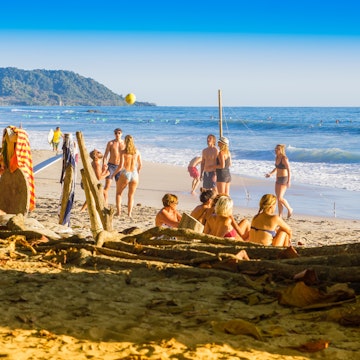
Young men kicking a soccer ball at a beach in Casablanca. Morocco. Andrea Vilchez
Ever since she was a young girl, photographer Andrea Vilchez has spent her life around the game of soccer. She was born in the small town of Somoto, Nicaragua, and her earliest memories were soundtracked by the noise of soccer balls hitting the shed that sat in front of her grandmother’s home, where kids from the neighborhood would come to play.
Today, she is based in Orlando, Florida, and her relationship with the sport has taken on a new life. A passion passed down from her father, who played professionally in Nicaragua, has transformed into a career. From action shots of the world’s biggest players on the field to vignettes of children playing in the streets of Morocco, Vilchez has followed the sport all over the world.
Here she shares some of her favorite soccer images and experiences.

Your dad played for the Nicaraguan National team – how did that shape your early views of soccer?
Advertisement
"Because my dad played professionally and was so well known for it in our small town, it felt only natural, and almost expected, for me to follow in his footsteps. I grew up watching him dedicate himself to the sport and to his team. He was obsessed with Real Madrid, and their rivalry with Barcelona was very popular in our country. So, not only was I able to view football through his experience as a player, but also as a fanatic of the sport myself.
"Even though the peak of his career happened when I was very young, I think one of the few things I noticed later on was the way soccer created a sense of community and dialogue. When he took me to matches, the team felt like friends and family. Some of them became lifelong friends for my dad, and to this day, they still treat me with great kindness when I go back home. On days when Real Madrid had a big match, he would take me to a party to watch, and I could feel that sense of community as we were cheering and watching the match on TV.
"By taking me to his games and trying to make me a Real Madrid fan, he instilled that same passion in me, and I welcomed it. Football was already so seamlessly embedded in my life before I started playing myself, but when I did, it felt like the most natural thing in the world."

You mentioned that during your first year in Florida, you couldn’t speak English. Soccer became a significant means of communication for you, and it was one of the few things that stayed constant during this period of transition. Can you talk a bit more about what this was like?
"When I came to Florida with my mom, it was a very shocking and hard transition for us both. We went from living with a very big family to just my mom and my stepdad in a country I didn’t know anything about. Even though I couldn’t bring the rest of my family with me, the one thing that followed me was my desire to continue to play soccer.
"One of the first things my stepdad did was sign me up to play soccer at the YMCA, and then eventually at an actual club team. For the first few years, I was very quiet and wouldn’t talk to any of my teammates at all, even after I learned to speak English.
"But going to soccer practice every day was essential for me. It gave me something to work towards and I was able to feel part of something, even if I didn’t even talk to my team. Looking back now, I know playing soccer was something I heavily relied on. It was like it grabbed me by the hand and slowly taught me how to make the connections that the 12- and 13-year-old me needed."


When you were injured during your senior year of high school, you had no choice but to sit on the bench. You then had the idea to start photographing the games – what can you tell us about that experience?
"At first, it was just really fun to photograph my teammates from the bench. They would have fun too, posing and laughing. I also caught candid moments in between, and some action on the field as well. Even though I enjoyed shooting and editing the photos of my team, I didn’t think much about the whole experience until after I showed them to a friend from art class."
I remember her feedback stuck with me for a long time because I valued her opinion as a great artist herself. After she saw my photos, she told me, 'Wow, maybe this could be your thing, sports photography.' And that was the moment that I felt something click in my mind. It immediately felt like I had found my new passion: photographing soccer."


Your soccer photography covers everything from on-the-field action shots of the world’s biggest players to quiet moments of children playing in the streets. Can you tell us how your experience of shooting these different scenarios varies? Do you prefer one over the other?
Advertisement
"I think the easy answer would be to say I prefer to do credentialed match coverage, since it’s what comes easiest to me and just because I enjoy the game so much. During a match, it’s all about technical creativity, accuracy and a little bit of luck.
"But although capturing a great celebration photo feels like a great accomplishment, the most gratifying work I’ve done has been from photographing in the streets. It challenges me in different ways, and it’s not something that comes easily to me.
"So when I am able to do it, and I look back at the work I did, I feel proud of everything I had to go through to take those photos. It also feels more like a vulnerable, human experience, which is something I’ve learned I value a lot more than sitting pitch-side."

What led you to your first big photography gig, and what was the shoot?
"As I was starting my senior year of college in 2023, I kept working on my photography career on the side. I would go to as many matches as I could to get my name out there and better my craft. One of those matches was the US Open Cup Final in Miami, where I introduced myself to the US Soccer Creative Director at the time, Xavi Dussaq.
"He had told me he was thinking of reaching out to me because he had seen my work, and sure enough, a few weeks later, he brought me on to be the team photographer for the new US Men’s U23 Olympic Team. I will forever be grateful to him, because that opportunity ended up being a key experience that helped me grow so much as a professional and a person.
"Getting an opportunity like that so early in my career brought a lot of nerves and self-doubt, but being surrounded by such great people (both staff and players) pushed me to be better. It also taught me some things about myself I wasn’t as aware of before.
"Some of my favorite memories happened off the pitch – celebrating a win after a friendly match, or sharing meaningful conversations with staff and players. It gave me a sense of belonging in a team environment that I had been missing since I had stopped playing soccer. I realized that I didn’t want to just photograph the action on the pitch, and what I valued more was the human connections I get through the sport."


What opportunities did that work lead you to?
"Being with the men’s Olympic team since October 2023 gave my work a new perspective, having all-areas access to a top team as the official team photographer and photographing soccer outside of the US. This opened doors to new opportunities, including with Football Case Study (FCS), a project exploring the role of soccer in society through photography.
"By September 2023, I was already in talks with Matthew Stith, the founder. At the time, Football Case Study was in the works, and for the next year, we discussed a future where we could work together more often, which led to me becoming one of the group's 12 members."


Football Case Study sent you to Morocco in 2025, where you spent a month documenting the Women's Africa Cup of Nations. Tell me about this experience!
"Spending a month documenting the Women’s Africa Cup of Nations (AFCON) was extraordinary. I'll always be grateful to Football Case Study for bringing me in on this project, because that’s where I was able to create some of my favorite work, as well as sharing an incredible experience I will cherish forever.
"I wasn’t sure what I was going to find photographing a women’s tournament in Morocco, a country so passionate about football, but what I did find surprised me in a wonderful way. Photographing from the stands showed me that the Moroccan people in the stadium were passionate and completely behind their team.
"It was incredible to see how many women, especially older women, attended the matches, and even made the most noise in the stadium. And those people who weren’t inside the stadium were still tuning in to every match at cafes. While I didn’t encounter as many girls while photographing soccer in the streets, it was clear that the tournament was an indication of the influence and growth of women’s soccer in Morocco.
Lastly, being able to stay for the entire month of the tournament gave me a real advantage. It was a privilege to be able to fully document every aspect and story of the tournament to create a well-rounded picture of how WAFCON was lived throughout the country."


Your work with agencies such as Getty Images and ISI Photos have led you to capture some of the biggest names in soccer. Do you have any major “pinch me” moments, and are there any players or teams you are itching to photograph one day?
"Photographing the Men’s Africa Cup of Nations Final in January was definitely a 'pinch me' moment. Documenting one of the world’s best football events, and an event with such rich history and culture, was a dream come true, especially after it turned out to be such a historic match.
"I also remember the surreal feeling of stepping onto the pitch to a sold-out crowd at Paris St Germain’s stadium in Paris for the Olympic men’s quarter-finals against Morocco. I was full of nerves and excitement, and although our team went home that night, it felt like one of the biggest moments I’ve been a part of so far. But one day, I really hope to photograph Liverpool in a special atmosphere at Anfield."


What has photographing soccer all over the world taught you about the game? Are there any threads that you always come across?
"Photographing soccer all over the world has taught me that the game welcomes people from all paths of life, all cultures and languages. It doesn’t matter where it is played. It could be at a 90,000 sold-out stadium, or under a highway bridge. It receives people into a global community, a passion, or even just a pastime. I have found that the game can be found anywhere and in many different ways, but it will always be welcoming."
What are you looking forward to for the 2026 FIFA World Cup? Do you have any plans for the games yet?
"I’m looking forward to seeing all the different cultures of fans that will come through the host cities during the World Cup. I think that’s the beautiful thing about hosting the biggest sporting event in the world – being able to see the way people all over the world show their passion for their nations and the sport.
"My plan is to cover the matches and fan stories around the tournament as a credentialed photographer, but regardless of whether my credentials are accepted or not, I want to make sure I document the soul and heart of the tournament, which is the people."
All photographs are by Andrea Vilchez.
Advertisement